Bandgap Simulations
The schematic test suite for the bandgap reference.
The cell under test
xschem/bandgap_tb.sch uses the core as a single symbol (bandgap_core.sym, with pins VDD, VSS and VREF) and adds only the outside world:
- VSUP: one supply source that carries DC (
vdd, default 1.8 V), AC 1 V for PSRR, and a PWL ramp from 0 V that only the transient start-up test uses. - CL: a 1 pF load on VREF.
- MODELS / CONTROL: the sky130 model library and a quick operating point plus temperature sweep, so Netlist → Simulate in xschem works straight away.
The output is unbuffered: VREF comes straight from the R2 branch, so it can't drive a resistive load. A real system would add a unity-gain buffer or LDO after it.
Results
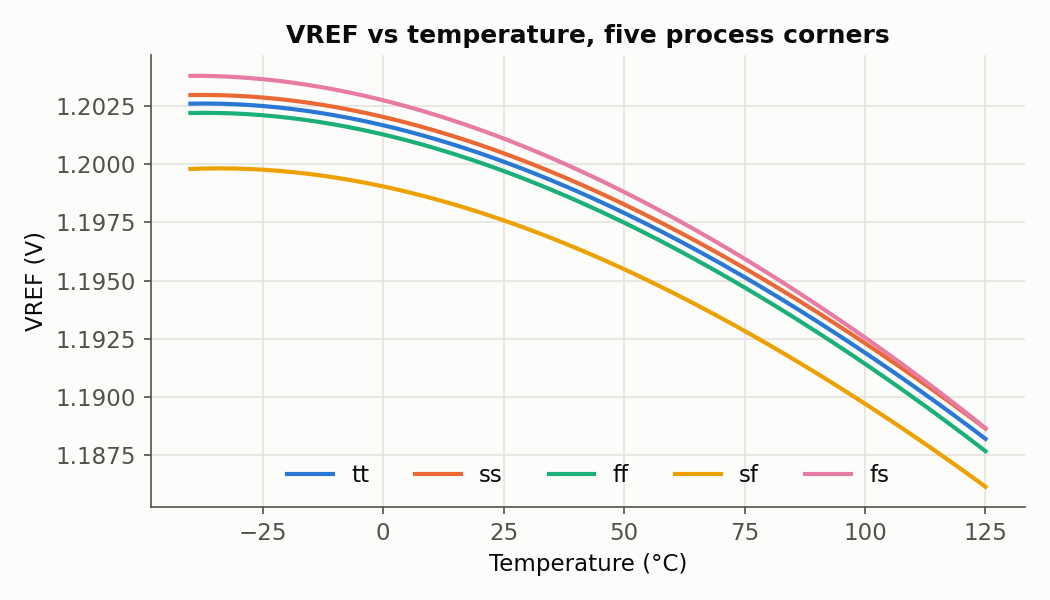
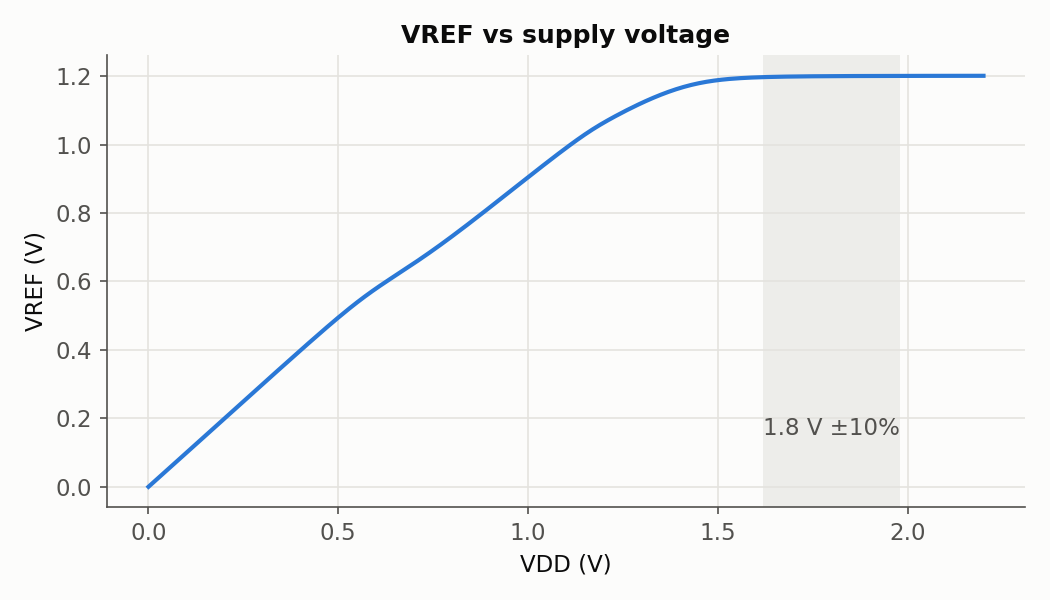
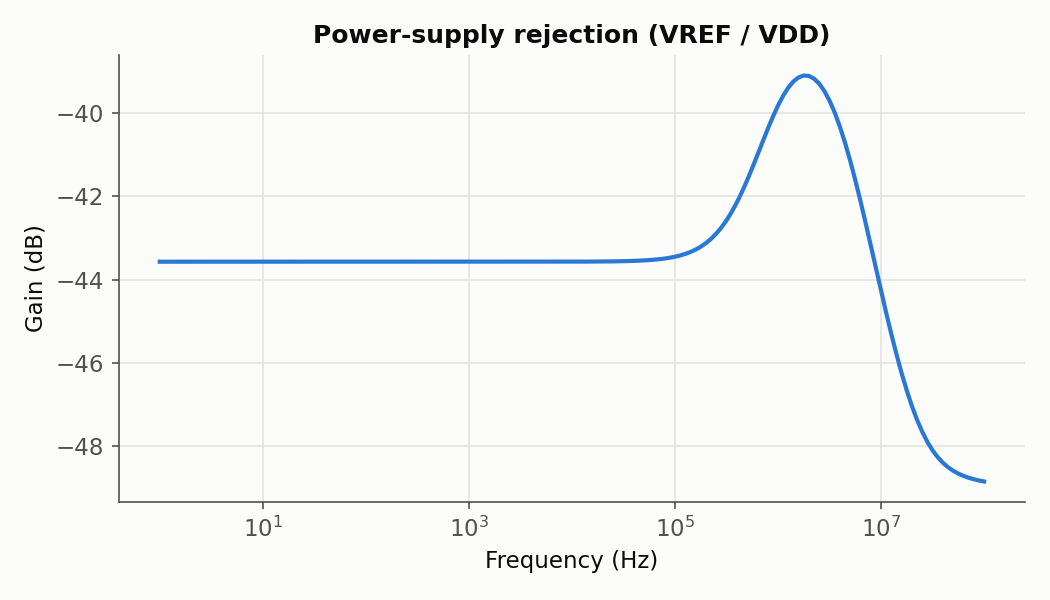
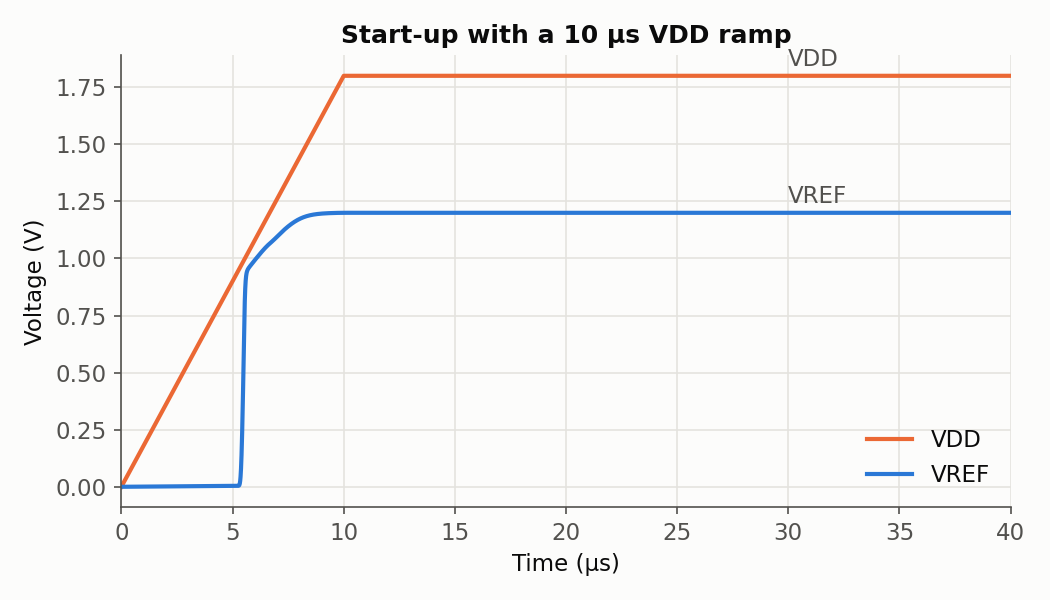
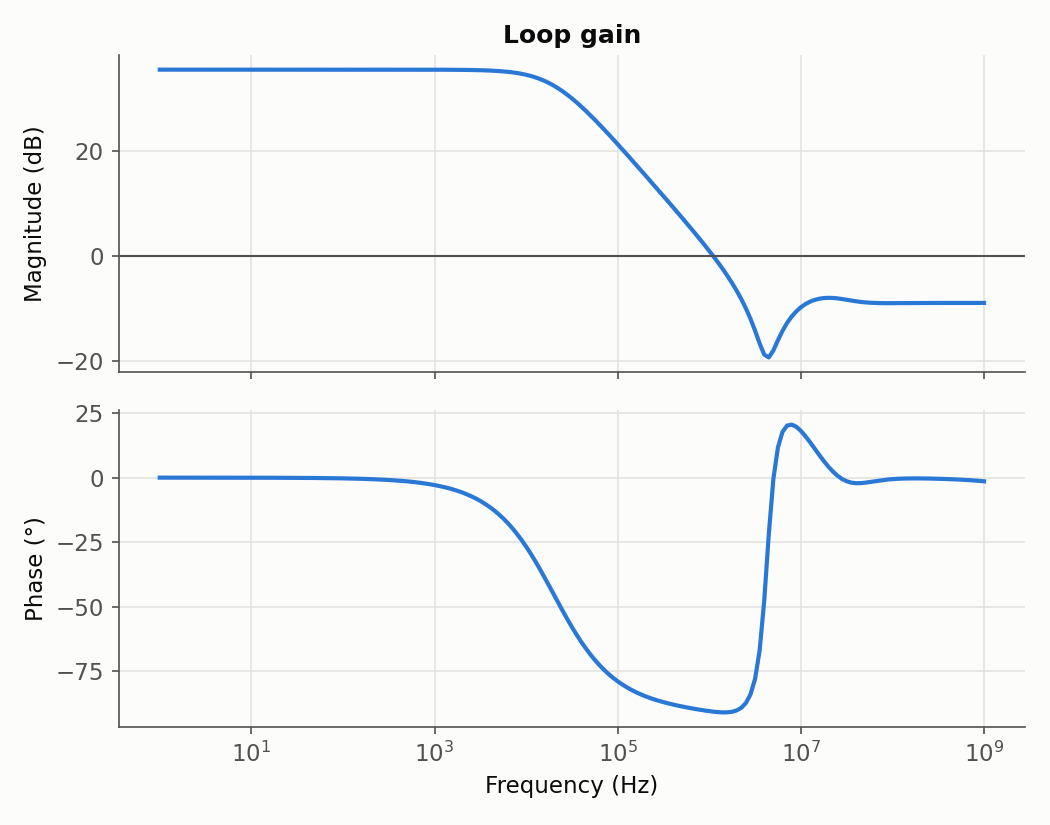
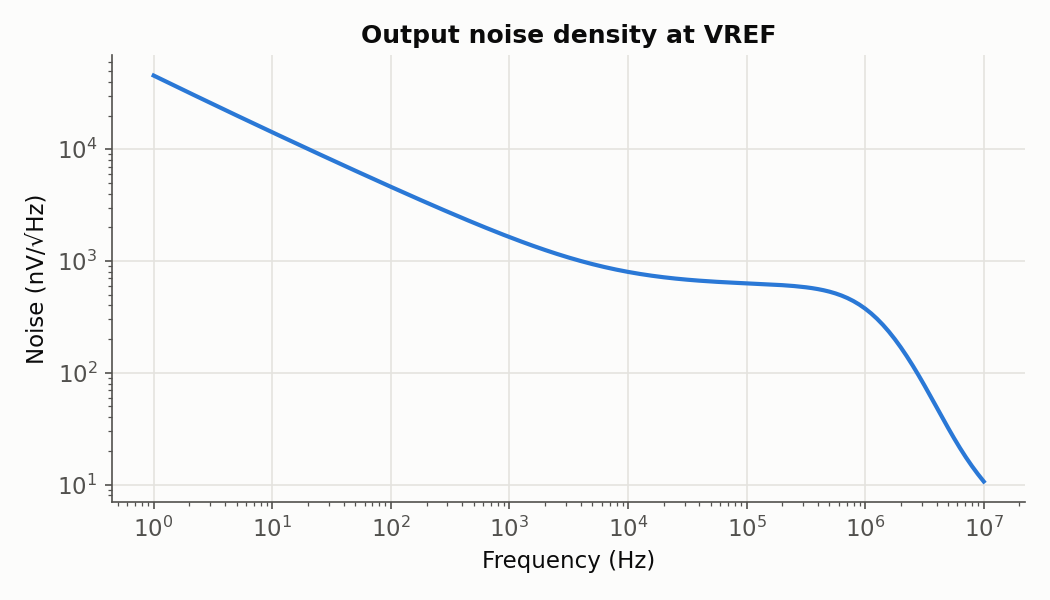
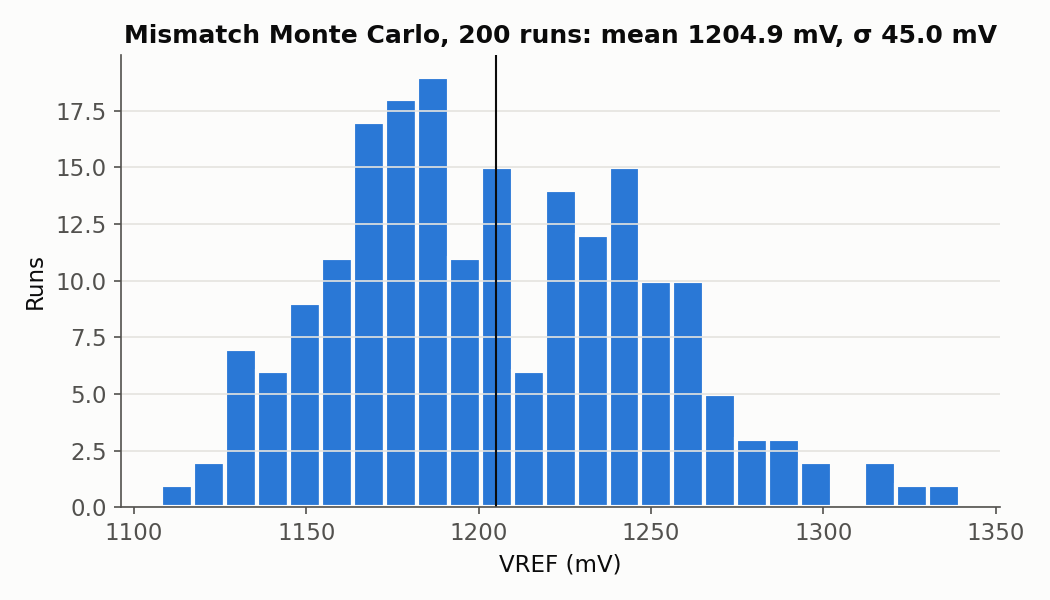
Plots from the schematic test suite. The table and notes below describe each test.
- Temperature
- Supply
- PSRR
- Start-up
- Loop gain
- Noise
- Monte Carlo
Schematic test suite
Every test lives in sim/bandgap/. The decks share bench.spice, the same circuit as the
testbench schematic. run_all.sh first netlists the schematic with xschem, so the tests always
simulate exactly what is drawn.
sim/bandgap/run_all.sh          # netlist + all tests (about 1 minute); logs and data in sim/bandgap/out/
python3 sim/bandgap/plot.py     # regenerate the plots on this page
ngspice sim/bandgap/temp.spice  # or run one deck interactively (after run_all.sh)
| # | Deck | What it checks | Result (tt, 27 °C) |
|---|---|---|---|
| 1 | op.spice | Operating point, supply current, amplifier offset | 1.2000 V, 20 µA, 0.04 mV |
| 2 | temp.spice | DC sweep −40 to 125 °C, box-method TC | 14.4 mV, 73 ppm/°C |
| 3 | line.spice | VDD swept 0 to 2.2 V | 9.9 mV/V; minimum VDD 1.51 V |
| 4 | psrr.spice | AC from VDD to VREF, 1 Hz to 100 MHz | −44 dB to 10 kHz, −40 dB at 1 MHz |
| 5 | startup.spice | Transient with a 10 µs VDD ramp from 0 V | settles at 8.4 µs |
| 6 | loop.spice | Loop gain, injected at Vloop | 36 dB, 1.1 MHz, PM 89° |
| 7 | noise.spice | Output noise density, 1 Hz to 10 MHz | 1.6 µV/√Hz at 1 kHz; 629 µV rms total |
| 8 | temp.spice × 5 | Temperature sweep at tt, ss, ff, sf, fs | 69 to 76 ppm/°C |
| 9 | mc.spice | 200 mismatch samples (tt_mm), each powered up by the VDD ramp | mean ≈ 1.20 to 1.21 V, σ ≈ 45 to 50 mV |
| 10 | sat.spice | Every transistor's against , at 1.8 and 1.62 V, run at −40, 27 and 125 °C | all analog devices saturated; worst margin 0.11 V |
Notes on the tests:
- Models. The decks use the PDK's
combinedmodel library, the one xschem's sky130 setup points to. The olderlibs.tech/ngspicelibrary gives a VREF about 27 mV lower for the same circuit. - DC hints. A self-biased circuit has more than one DC solution, and the solver doesn't always find the right one.
bench.spicesets.nodesetguesses for VREF, PB, A and B. The temperature sweep runs outward from 27 °C in both directions, because a single −40 to 125 °C sweep jumped to an unstable solution near 1.7 V at three corners. That state isn't real: a transient started from it falls back to 1.2 V. The start-up and Monte Carlo tests run in the time domain without these hints, so they check that the circuit reaches its operating point unaided. sat.spiceis generated bymake_sat.pyfrom the netlist, so it always covers every transistor in the schematic.- Monte Carlo results change slightly between runs, because ngspice draws new random values each time.
The same tests on the extracted layout are on Post-layout simulation.